
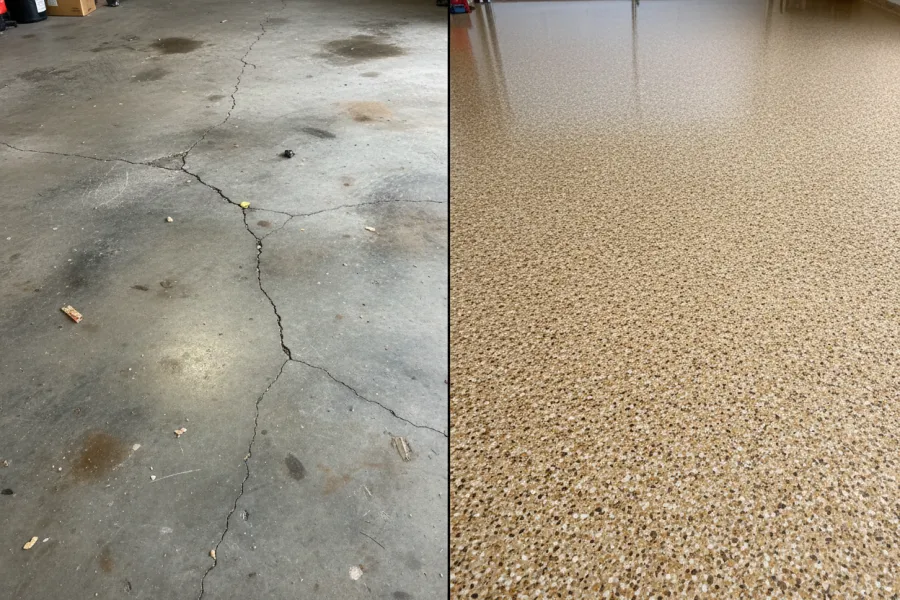
Can you epoxy over cracked concrete?
Yes, and it is done every day, but only after the cracks are repaired. Hairline and shrinkage cracks get routed out, filled with the right repair material, and ground flush, and then the coating goes over sound concrete. What you cannot do is coat over open cracks and hope: the coating will mirror them back through and let moisture undermine the bond.
Cracked slabs are the normal starting point for our garage floor epoxy work, not the exception. Here is how the pros sort crack types, what repair involves, and the few situations where a crack means a bigger conversation.
Which cracks are routine and which are red flags?
Most cracks in a Florida garage or interior slab are cosmetic history, not active problems:
| Crack type | What it means | Coatable? |
|---|---|---|
| Hairline / shrinkage | Normal curing, especially fast hot Florida cures | Yes, after fill |
| Crazing (map cracking) | Surface-level finishing artifact | Yes, grinding handles it |
| Joint cracks | Slab moving at its designed control joints | Yes, joints treated properly |
| Spalling / pitting | Surface breakdown, moisture or wear | Yes, after patch rebuild |
| Displaced (one side higher) | Slab sections moving independently | Not until the movement is addressed |
| Wide, growing, or settling | Soil or structural movement underneath | Needs concrete work first |
The last two rows are the honesty rows. A coating is a wear surface, not a structural repair, and covering an active movement problem just hides it while it worsens. When we see displacement or settlement at a quote, we say so and point you to concrete work first, because coating it would waste your money on a season of good looks.
What does proper crack repair actually involve?
Not caulk, and not the coating itself. The crack gets chased with a crack-routing blade to open it into a clean, sound channel, vacuumed out, and filled with a rigid repair material made for the job, typically a fast-setting polymer or epoxy-based filler that bonds the walls of the crack. Once cured, the repair gets ground flush with the surrounding slab during the same diamond-grinding pass that preps the whole floor.
That grinding pass matters beyond the repairs. It opens the pores of the entire slab so the base coat anchors mechanically, which is the real difference between a professional floor and a peeling kit job. Repairs done into a ground, open slab become part of the floor; filler smeared on a sealed surface becomes a future flake-out.
Why do Florida slabs crack the way they do?
Heat and ground, mostly. Concrete poured in Florida summer cures fast, and fast cures produce shrinkage cracking, the fine random lines you see in almost every garage from the subdivision boom years. Sandy soils compact and settle a little in the first years after a build, which prints minor cracking near edges and corners. And moisture moving up through the slab can degrade surfaces into pitting and spalling over the decades.
All of that is standard, repairable, coatable history, which is exactly what we deal with across the builder-slab belt in places like Brandon. The one Florida factor that is not visible is moisture itself, which is why a moisture check precedes coating on every slab, cracked or pristine: elevated readings call for a mitigation primer under the system, and testing is the only way to know.
Does the finish hide the repairs?
Choose the right finish and yes, almost perfectly. A full-broadcast flake floor buries repairs under a dense multi-color texture, and even wide patch areas vanish into it. That is why flake is the default recommendation on older, repaired slabs. Smooth solid colors and metallics are less forgiving, and under hard garage lighting a careful eye can find a ghost of a large repair. We flag exactly that trade-off with samples in hand at the estimate, and the same logic applies on interior floors too.
If your slab is cracked and you have been assuming that disqualifies it, it almost certainly does not. Send photos or let us walk it: quotes are free, the repair scope gets named upfront, and we answer 24/7 at (727) 423-5985 or through the quote form.