
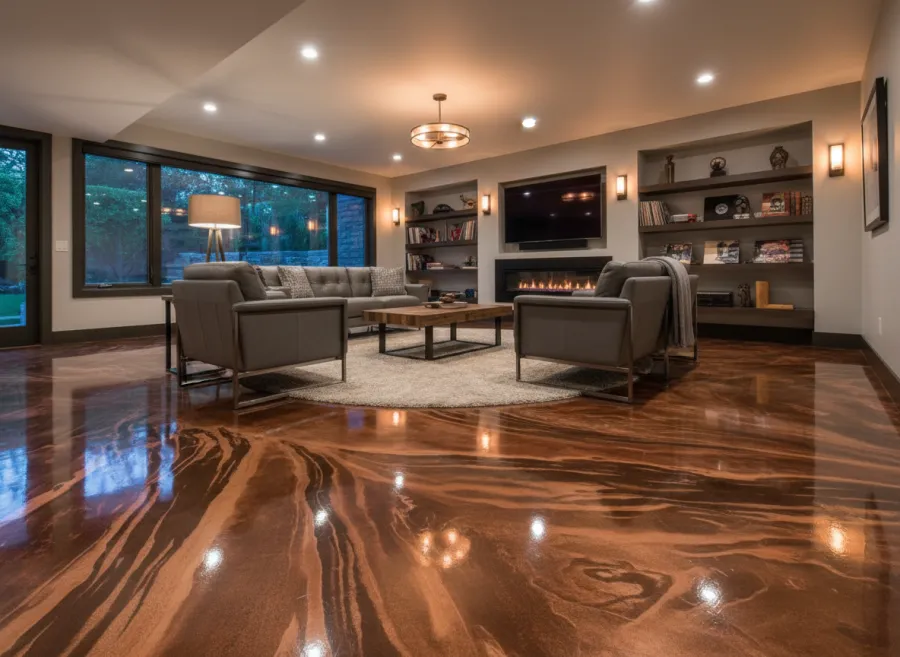
Can you put epoxy floors inside a Florida home?
Yes. Any interior concrete slab in the house is a candidate for epoxy: laundry and utility rooms, mudrooms, enclosed sunrooms and lanais, kitchens, home gyms, and living areas. One honest framing point up front, though. Most Florida homes have no basement, so “interior epoxy” here means coating a ground-floor slab, not a below-grade room. The applications are real; the word basement mostly is not.
Garages are the usual home for epoxy, but the rest of the house is fair game. Coated interior concrete turns bare or dated slabs into bright, hard-wearing, grout-free floors. Here is where an interior floor coating fits inside a Florida home, the honest trade-offs, what it costs, and which finish suits which room.
Why do Florida homes rarely have basements?
Florida homes are built slab-on-grade, directly on a concrete pad, and basements are the exception rather than the rule. The main reason is the water table. Across much of the state, groundwater sits close to the surface, often within a foot or two, so a dug-out basement would take on water or stay perpetually damp. During the rainy season the ground gets wetter still.
The soil and geology add to it. Florida sits on porous limestone that is prone to sinkholes, over sandy, shifting soil that does not support deep foundations well. Excavating and waterproofing a dry basement in that ground is expensive and risky, and being below grade in a flood-prone, hurricane-exposed state invites water damage. So builders pour a slab, and that slab is exactly what makes epoxy a natural interior floor here: it is already concrete, ready to grind and coat.
Which rooms inside the house suit epoxy?
Interior epoxy works best in rooms that deal with moisture, mess, or hard use, and in spaces where you want a statement floor. The common picks:
- Laundry and utility rooms. No grout lines to collect grime, nothing that traps humidity underneath, and a floor you can wet-mop without a second thought.
- Mudrooms and entries. Sand, rain, and daily traffic wipe up instead of wearing the floor down.
- Sunrooms and enclosed lanais. A coated slab ties an indoor-outdoor room together and shrugs off the humidity these spaces carry.
- Kitchens. A continuous, easy-clean surface with no seams for spills to hide in. A growing number of homeowners use epoxy here for the look.
- Home gyms and studios. A hard, durable surface that takes equipment, dropped weights, and sweat, then cleans up fast.
- Living areas and remodels. Where a metallic or designer flake floor becomes the centerpiece of the room.
Grinding inside a finished home is cleaner than most people expect, since the prep is done with dust-extracting equipment and the work area is contained.
What does an interior epoxy floor cost?
Interior epoxy is priced like any other epoxy work, by the finish and the condition of the slab. Installed ranges from national cost guides such as This Old House and HomeGuide:
| Finish | Installed cost per sq ft |
|---|---|
| Solid color epoxy | $3–$8 |
| Flake system | $5–$10 |
| Metallic | $8–$15 |
A 300 square foot room lands well inside those per-foot numbers, so a solid-color laundry room sits at the low end and a metallic living-room floor at the high end. Slab condition moves the price: crack repair, old flooring removal, and moisture prep all add before the coating goes down.
Those are market ranges, not a quote from us. Every interior slab is different, so we look at the room and the concrete first, then quote. Quotes are free and no-obligation, and we answer the phone 24/7.
What are the honest downsides inside a home?
Epoxy is a hard floor, and indoors that cuts both ways. It has no give, so standing on it for long stretches, at a kitchen counter or a workbench, is more tiring than standing on wood or cushioned flooring. It also feels cold underfoot, especially in a room without a rug or underfloor heating. Neither is a dealbreaker, and both are what area rugs are for, but you should know it going in.
A coated floor is also slick when wet if it is finished smooth, so in a kitchen or laundry we build in texture, a flake surface or a grip additive in the topcoat, rather than a bare glass finish. And the one that matters most in Florida: epoxy sheds water from the top, but it does not stop moisture rising from below. A coating over a slab that is releasing vapor can blister, so an interior floor still gets a moisture check before anything goes down. Handled right, that is a standard step, not a problem.
What finishes work inside a home?
The full range is on the table indoors. A clean solid color suits utility rooms and minimal spaces. A full-broadcast flake system hides dust and everyday dirt and adds slip resistance, which makes it a practical all-rounder for laundry rooms, gyms, and mudrooms. And a metallic epoxy floor is the showpiece, marbled and glossy, for a living area, kitchen, or remodel where the floor is meant to be the feature.
One advantage interior floors have over outdoor ones: no direct sun. Standard epoxy ambers under UV, which is why outdoor floors need a UV-stable topcoat, but an interior floor out of the light holds its color for years without that constraint. That is part of why some of the best-looking floors go inside the house rather than in the garage.
If you are thinking about an epoxy floor for a laundry room, sunroom, kitchen, gym, or living space anywhere across Tampa Bay, we will look at your slab and give you a straight number: get a free interior floor quote or call (727) 423-5985. If you want to compare the decorative options first, start with what a metallic epoxy floor costs or how a full-broadcast flake floor is built.