
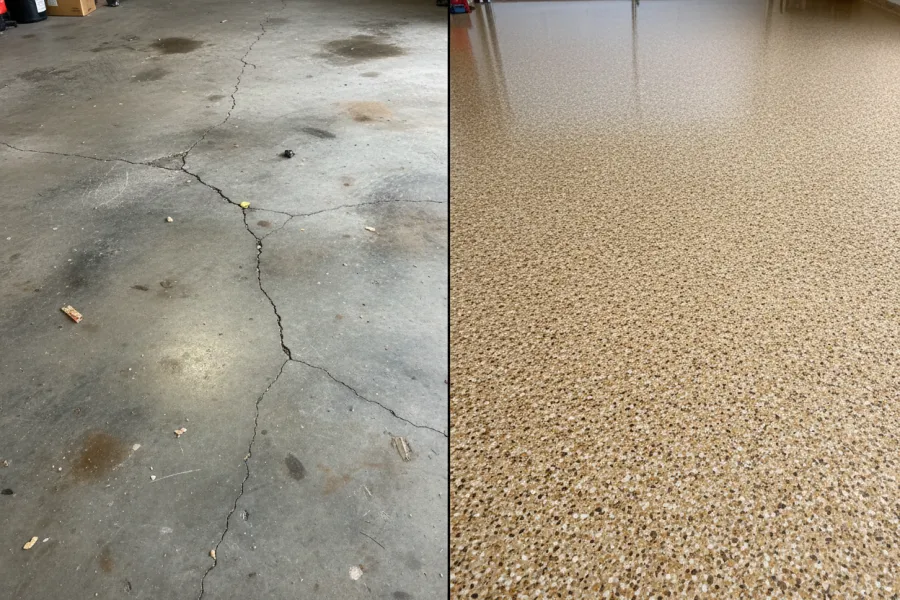
How long does an epoxy floor last in Florida’s heat and humidity?
A professionally installed epoxy floor is generally rated 10 to 20 years, and 20-plus years when it is finished with a polyaspartic or urethane topcoat. Big-box DIY kits last far less, often 1 to 3 years for water-based products. In Florida, the two things that move that number are UV in direct sun and moisture rising through the slab, and both are solved by the right system rather than luck.
The honest headline: how long your floor lasts depends more on how it was installed than on the weather. Prep quality and the topcoat decide most of it. Here is what an epoxy garage floor actually lasts in Florida, what shortens it here specifically, and how a good install adds years.
How long does an epoxy floor really last?
Lifespan tracks almost entirely with build quality. A thin DIY coat over an etched slab and a thick professional system over ground concrete are different products with different lifespans. Published figures by type:
| Floor type | Typical lifespan |
|---|---|
| Big-box DIY water-based kit | 1–3 years |
| Mid-tier DIY kit | 2–4 years |
| Professional epoxy | 10–20 years |
| Professional epoxy + polyaspartic/urethane topcoat | 20+ years |
| Standard epoxy under heavy commercial traffic | as little as 2–5 years |
This Old House, Bob Vila, and Today’s Homeowner all put professionally installed epoxy at 10 to 20 years, with solid systems reaching two decades and beyond. Today’s Homeowner also notes the other end: water-based products need reapplying every 1 to 3 years, and standard epoxy in a heavy-use area can wear in as little as 2 years. The spread is not really about epoxy versus epoxy. It is about thickness, prep, and the topcoat.
What shortens an epoxy floor’s life in Florida?
Three things do most of the damage here, and none of them is the cold. Freeze-thaw cycling, the repeated freezing and thawing that cracks slabs and lifts coatings up north, is not a Tampa Bay concern, because the ground does not freeze. Florida floors trade that for a different set of stresses:
- UV in direct sun. Standard epoxy ambers and loses gloss under sunlight. On an open patio, lanai, or a garage with the door up all day, an unprotected epoxy clear yellows over time.
- Slab moisture. Florida homes sit on slab-on-grade concrete over damp, often high-water-table ground. Vapor migrates up through the slab, and a coating applied over an untested slab can blister and peel, sometimes within a year or two.
- Hot-tire pickup. A parked tire comes off the road at 140 degrees or more, softens a thin or weakly bonded coating, and lifts it as it cools. It is the classic failure of cheap epoxy over skipped prep.
Each of these has a fix, and each fix is something you specify before the floor goes down. That is the whole point: in Florida, the install choices decide the lifespan more than the calendar does.
Does Florida sun really amber epoxy?
Yes, and it is chemistry rather than opinion. Epoxy resin is built on an aromatic ring structure that absorbs UV, so the coating yellows and chalks under direct sun. A 2024 technical article in CoatingsTech, the American Coatings Association’s journal, ran standard epoxy through a 500-hour accelerated weathering test: it yellowed sharply and kept as little as 12 percent of its gloss, while a UV-stable topcoat in the same test barely changed.
Manufacturers design around this instead of denying it. Sherwin-Williams sells a UV-stable resin line marketed on keeping floors from yellowing, and outdoor flake systems pair UV-rated flake with a UV-stable polyaspartic or urethane topcoat. The takeaway for lifespan: where sun reaches the floor, the wear coat has to be UV-stable, or the floor will look aged long before it is worn out. Indoors, out of direct light, standard epoxy holds its color for years. This matters most on patio and pool deck coatings and any garage that lives with the door open.
How do prep and the topcoat add years?
The two decisions that add the most life both happen before the first coat. Prep is the first. Diamond grinding profiles the concrete so the coating bonds into it mechanically, and a moisture check catches a wet slab before it ruins the job. Grind-and-test costs more than an acid etch and a quick pour, and it is the single biggest reason one floor lasts 15 years and another peels in two.
The topcoat is the second. The clear wear layer takes all the abuse, the traffic, the sun, and the hot tires, so it decides how the floor ages. A UV-stable polyaspartic or urethane wear coat is what pushes a system past 20 years and keeps it from yellowing outdoors. This is why most durable Florida floors use two chemistries: an epoxy or polyurea base for build and adhesion, then a polyaspartic top for wear and UV. A full-broadcast flake system built this way adds a real material layer that outlasts a thin coat, and the deeper comparison is in our guide on epoxy vs. polyaspartic coatings.
How do you maintain an epoxy floor so it lasts?
Maintenance on a quality floor is genuinely light, and doing it does extend the life. Grit is the enemy: sand and dirt underfoot act like sandpaper on the clear coat, so the main job is sweeping or dust-mopping it off. Wet-mop with a mild, neutral cleaner when the floor needs it, and wipe spills, oil included, before they sit. There is no wax to strip and no sealing schedule for a professional system.
A few habits help outdoors and in the garage. Put a mat under a motorcycle kickstand or a jack stand, since concentrated point loads press harder than tires. Rinse a coated lanai or pool deck after salt or sunscreen exposure. None of it is demanding, and it is the difference between a floor that looks installed-yesterday at year 10 and one that looks tired at year 5.
If you want a floor built to last in Florida, the parts that matter are prep, the topcoat, and moisture testing, not a brand slogan. We quote each floor after seeing the slab, and the quote spells out the grinding, the coats, and the topcoat. For a straight number on your garage in Tampa, St. Petersburg, Clearwater, or anywhere across Tampa Bay, get a free garage floor quote or call (727) 423-5985. For the cost side, see what an epoxy garage floor costs in Florida.