
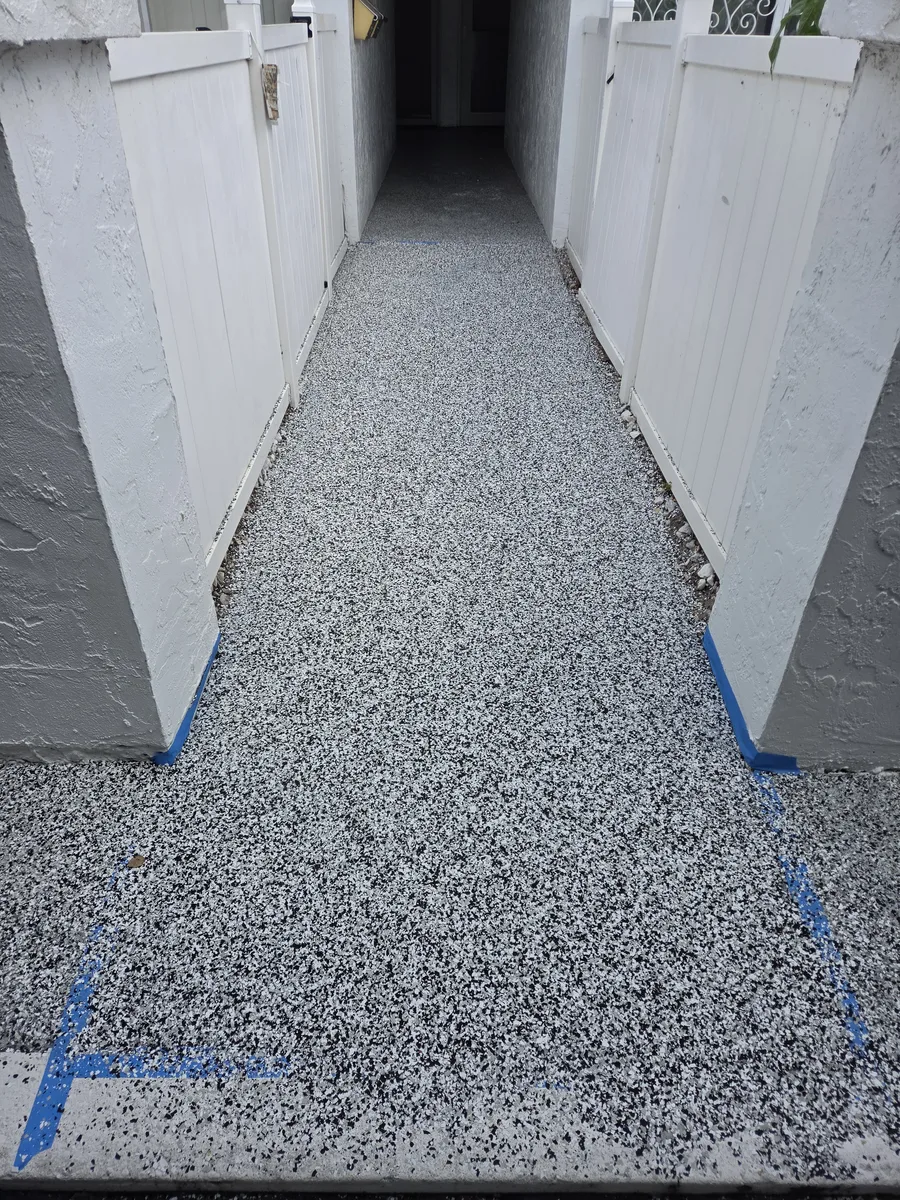
How much does a driveway coating cost in Florida?
Published ranges put a driveway coating at about $4 to $12 per square foot installed. HomeGuide lists epoxy at $4 to $10 and polyaspartic at $5 to $12 per square foot. Decorative flakes add $0.50 to $2.00 in HomeGuide’s data. HomeGuide’s total for an epoxy-coated driveway is $1,200 to $5,800. Your real number needs an on-site look.
We coat driveways, walkways and entry paths across Pinellas, Hillsborough and Pasco counties and the city of Sarasota. Every job is a flake or polyaspartic system over existing concrete, ground and repaired first. This post lays out the published price bands and what moves your number inside them. Our driveway and walkway coatings page covers the systems themselves.
What does a driveway coating cost per square foot?
Most published data lands between $4 and $12 per square foot for a coating system. A plain sealer runs $1 to $3. HomeGuide lists epoxy at $4 to $10, polyaspartic at $5 to $12 and polyurea at $5 to $10. Angi lists epoxy at $2 to $12 per square foot.
| System on exterior concrete | Published range | Source |
|---|---|---|
| Epoxy coating | $4–$10 per sq ft | HomeGuide |
| Epoxy coating | $2–$12 per sq ft | Angi |
| Polyurea coating | $5–$10 per sq ft | HomeGuide |
| Polyaspartic coating | $5–$12 per sq ft | HomeGuide |
| Decorative flake add-on | $0.50–$2.00 per sq ft | HomeGuide |
| Thick epoxy, garage floor | $10–$15 per sq ft | Fixr |
| Epoxy-coated driveway, total | $1,200–$5,800 | HomeGuide |
| Concrete sealing only | $1–$3 per sq ft, $575–$1,700 for a 2-car driveway | HomeGuide |
| Concrete resurfacing (overlay) | $3–$7 per sq ft | HomeGuide |
A full-broadcast flake driveway sits in the polyaspartic band plus the flake add-on. The flakes and the UV-stable topcoat are the parts that survive outdoors. HomeGuide notes epoxy is slightly cheaper than polyurea and polyaspartic but not as durable. For the topcoat side of that price, see our post on polyaspartic floor coating cost in Florida.
What drives the price up or down?
Prep, repairs, size and the system set the price. A driveway that needs grinding, crack repair and spall patching costs more than a sound slab. Larger driveways cost less per square foot because setup is spread over more area. A polyaspartic or flake system costs more than plain epoxy but lasts longer outdoors. Flake blends and colors add a little.
Prep is the big one. We diamond grind every slab. HomeGuide lists the related line items. Power washing runs $0.35 to $0.77 per square foot and driveway crack repair $100 to $400. Moisture testing runs $50 to $300. Concrete resurfacing runs $3 to $7 per square foot when a slab is too rough to coat directly. HomeGuide also lists coating labor at $3 to $6 per square foot on its own.
Size cuts the other way. HomeGuide’s polyaspartic guide notes larger areas raise the total but usually lower the cost per square foot. A long driveway plus a front walkway often prices better per foot than the walkway alone. We quote the whole path at once so you can see the difference.
Why does Florida sun change the system we recommend?
Florida sun rules out plain epoxy as an exposed driveway finish. Coating supplier Zeraus states there is no truly UV-resistant epoxy. Coated Local calls sun yellowing the most common complaint on Florida installs. World Population Review ranks Florida fourth for annual UV irradiance. HomeGuide notes polyaspartic resists UV yellowing, so outdoor jobs get a polyaspartic or urethane topcoat.
Heat is the second problem. Solomon Colors, a concrete color maker, reports concrete in direct sun runs 30 to 50 degrees hotter than the air. An 80-degree day can put a gray slab at 110 to 130 degrees. HomeGuide’s comparison lists polyaspartic as highly flexible through expansion and contraction cycles, and epoxy as more brittle. A rigid coating on a slab that swings that much cracks and lifts.
Crystal Clear Epoxys lays out the timeline for standard epoxy in UV. Slight yellowing shows at 3 months, moderate at 6 and severe at 12. That is one Florida summer. Our post on epoxy vs polyaspartic in Florida goes deeper on why the topcoat matters more than the base outdoors.
What about hot tires on a driveway?
Hot-tire pickup is a coating peeling where a car parks. Hello Garage reports tires can reach upwards of 140 degrees in summer. All Garage Floors traces most failures to cheap water-based epoxy that re-softens under that heat. Concrete that was never ground is the other cause. A ground slab and a heat-tolerant topcoat prevent it.
All Garage Floors adds a second cause. Plasticizers and paraffin in tire rubber migrate out when tires get hot and sit on the concrete. Grinding removes that residue before the base coat goes down. On a driveway the tires arrive hotter than in a garage, straight off the road. So the topcoat choice carries more weight. For the failure modes we see most, read why epoxy floors peel in Florida.
How long does a driveway coating last?
Published lifespans favor polyaspartic outdoors. HomeGuide lists polyaspartic and polyurea coatings at 10 to 20 or more years. It lists epoxy at 3 to 20 years. Sealers are shorter. HomeGuide puts acrylic sealers at 1 to 3 years and epoxy or urethane sealers at 5 to 15 years. Concrete resurfacing lasts 8 to 15 years before repairs.
ArmorGarage, a coating manufacturer, frames the gap another way. A sealer is water-thin and sits mostly below the surface. A coating cures into a layer many times thicker. ArmorGarage puts coating life against sealer life at about 4 to 1. On a Florida driveway the sun and the daily heat cycle shorten anything thin. Our polyaspartic floor coating systems are the fast-cure, UV-stable topcoats we put on exterior concrete.
Is a coating better than sealing or resurfacing a driveway?
They solve different problems. A sealer protects sound concrete from water and stains for a few years. HomeGuide lists it at $1 to $3. Resurfacing is a cement overlay that hides a rough or spalled surface at $3 to $7 per square foot. A coating system is a bonded, UV-stable finish at $4 to $12 per square foot.
HomeGuide notes an epoxy driveway coating protects against stains and keeps weeds from growing in cracks. It also notes sealants use a very thin layer that only protects against water or stains. Coatings add grip too. A full flake broadcast leaves a texture in the topcoat. Epoxy Plus notes full-broadcast flake is less slippery than a smooth resin floor. On a walkway that sees afternoon rain, that texture is the point.
Want a real number for your driveway? Request a free on-site quote through our driveway coating service page or call (727) 423-5985. We look at the slab, test for moisture and price the system that fits the sun and traffic.