
What does a grind and seal concrete floor cost in Florida?
Grind and seal is the lowest-cost finished concrete floor in published data. Bob Vila lists sealed concrete at $0.85 to $1.60 per square foot over its $2 to $8 standard-job range. HomeGuide puts sealing at $1 to $3, polished concrete at $3 to $12 and epoxy at $4 to $10. An on-site look sets the real number.
We grind and seal floors for businesses and homes across Pinellas, Hillsborough and Pasco counties and the city of Sarasota. This post lays out the published price bands, the process, and how the finish compares with polished concrete and epoxy. Our grind and seal concrete floors page covers the service itself.
What is a grind and seal concrete floor?
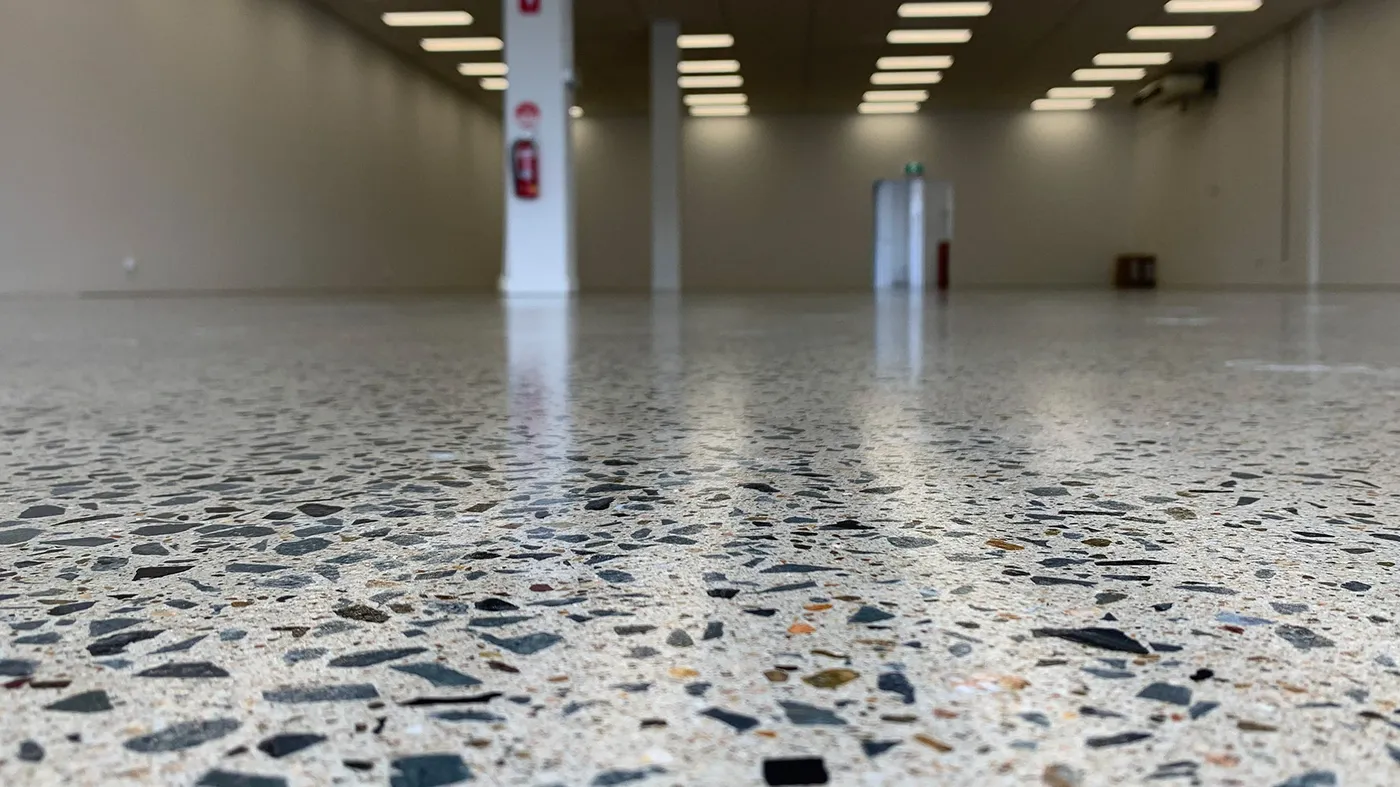
A grind and seal floor is existing concrete, diamond ground smooth, repaired and sealed with a clear coating. Westcoat, a coating manufacturer, defines it as grinding interior concrete floors and applying a clear topcoat or sealer. Niagara Machine describes one or two metal-bond grinding steps, a cleaning, then two coats of sealer. The sealer supplies the shine and protection.
The grinding pass is coarse on purpose. DiamaPro’s example schedule starts metal-bond tooling at 30 and 70 grit. Grind and seal stops in that range instead of moving on to fine resin diamonds. That flattens the slab, removes old coatings and glue, and opens the surface so the sealer bonds. Cracks and spalls get repaired before the sealer goes down.
Sherwin-Williams frames sealed concrete as a step up from plain concrete. Plain concrete is not stain or moisture resistant and tends to dust. Sealing adds abrasion, chemical and stain resistance and stops the dusting. That is the point: a clean, hard floor that costs less than a polish or a resin build.
How does grind and seal compare with polished concrete and epoxy?
Grind and seal is the fewest steps and the lowest price. Polished concrete is the most steps and the longest life. Epoxy is the thickest protection. Niagara Machine notes a sealed floor resists abrasion less than a polished floor. Bartell Global notes sealers wear and need recoating. Prosoco notes epoxy adds a thick layer that resists oil, solvents and acids.
| Factor | Grind and seal | Polished concrete | Epoxy coating |
|---|---|---|---|
| Process | 1–2 coarse grinding steps, then sealer (Niagara Machine) | 6–12 grinding steps with densifier (Wikipedia) | Grind, repair, resin base coat, topcoat |
| Sheen | Flat, matte or gloss by sealer choice | Matte to mirror gloss by grit level | Gloss, satin with some topcoats |
| Chemical resistance | By sealer; urethane and epoxy sealers highest | Stain resistant, not chemical resistant (Sherwin-Williams) | Resists oil, solvents and acids (Prosoco) |
| Wear | Sealer recoated every few years | Surface itself hardened, decades of use | 10–20 years for solid epoxy (HomeGuide) |
| Published cost | $0.85–$1.60 over a $2–$8 base (Bob Vila) | $3–$12 basic (HomeGuide) | $4–$10 (HomeGuide) |
| Best fit | Warehouses, retail, garages, budget refreshes | Showrooms, retail, long-hold buildings | Wet, chemical and heavy-traffic floors |
Polished concrete earns its price with time. National Concrete Polishing notes retail polished floors need only sweeping and damp mopping and can pass 20 years. Wikipedia notes grind and seal is not considered polished concrete because the surface gets very little refinement. Its topical coating wears off with traffic and gets replaced. Epoxy is the answer when the floor gets hit with chemicals or water. Our commercial flooring options page covers when we steer a business toward a full resin system.
What do the sealer choices change?
The sealer decides the sheen, the chemical resistance and the recoat schedule. Concrete Network describes four families. Penetrating sealers leave no film and a matte look. Acrylics are easy and economical but wear faster. Polyurethanes are nearly twice as thick and non-yellowing. Epoxies are hard-wearing but yellow in sun. Grind and seal can use any of them.
Sheen ranges from flat to wet-look gloss. General Industrial Flooring notes flat, matte and glossy sealers all exist. Westcoat offers a flat sheen option that keeps the durability. Prosoco adds that polyaspartic sealers cure fast, resist yellowing under sun and go on thicker than most epoxies. That is why we use polyaspartic as the top layer on floors that need a quick turnaround.
Densifiers are a different tool. Prosoco explains they react with the concrete to harden the wear layer and cut dust. They never peel or need reapplication because they become part of the slab. A densifier under a sealer gives a tougher floor than a sealer alone.
How long does a grind and seal floor last?
The concrete lasts; the sealer is the wear item. HomeGuide puts acrylic sealers at 1 to 3 years and epoxy or urethane sealers at 5 to 15 years. Bartell Global notes sealers wear off in traffic lanes and need a recoat. A recoat is a cleaning and a new coat, not a new floor.
Florida moisture is the other lifespan factor. Sherwin-Williams notes sealed concrete stays moisture sensitive, with a 75 percent relative humidity threshold. It recommends in-situ testing per ASTM F2170. Coated Local reports Florida slabs regularly push more vapor than standard coatings tolerate because water tables sit high. We moisture test before quoting any sealer. On a wet slab we pick a breathable or moisture-tolerant system. For a longer look at how coatings age here, read how long an epoxy floor lasts in Florida.
Where does grind and seal fit best?
It fits floors that need to look clean and hold up without a resin build. Westcoat lists showrooms, warehouses, entryways, retail stores, breweries, restrooms, garages and offices. Prosoco points to warehouse slabs and retail floors where dusting under traffic is the main complaint. Patios work too with a UV-stable sealer; Concrete Network notes epoxy sealers yellow outdoors.
Warehouses are the most common call. A ground and sealed slab stops dusting and handles pallet jacks at a fraction of a resin floor’s cost. Heavy forklift lanes are the exception. Sherwin-Williams notes those areas often get quarter-inch aggregate-filled epoxy, which is where our industrial floor coatings come in. Garages come next. Prosoco notes water-based acrylics may have less resistance to tire marking, so a garage gets a polyaspartic or urethane top. Our post on commercial epoxy flooring in Tampa Bay covers the resin side for retail.
What moves the price on a grind and seal job?
Slab condition, floor size and sealer choice move the price. Angi lists removing old coatings at $1 to $3 per square foot and moisture mitigation at $2 to $6. HomeGuide lists acrylic sealers at $1.00 to $2.00 installed, polyurethane at $1.25 to $3.00 and epoxy at $4.00 to $10.00. Big open floors land near the bottom of each range.
| Cost item | Published range | Source |
|---|---|---|
| Sealed concrete finish | $0.85–$1.60 per sq ft over a $2–$8 base | Bob Vila |
| Concrete sealing, installed | $1–$3 per sq ft | HomeGuide |
| Acrylic sealer, installed | $1.00–$2.00 per sq ft | HomeGuide |
| Polyurethane sealer, installed | $1.25–$3.00 per sq ft | HomeGuide |
| Epoxy sealer, installed | $4.00–$10.00 per sq ft | HomeGuide |
| Polyaspartic sealer, installed | $4.00–$9.00 per sq ft | HomeGuide |
| Removing old coatings or adhesives | $1–$3 per sq ft | Angi |
| Moisture mitigation | $2–$6 per sq ft | Angi |
| Polished concrete, commercial | $5–$12 per sq ft | Angi |
| Polished concrete, over 5,000 sq ft | $3–$6 per sq ft | HomeGuide |
Bigger floors price better. HomeGuide notes polished jobs over 5,000 square feet can drop to $3 to $6 per square foot. Small rooms carry premium pricing. The same setup math applies to grinding. A floor with old tile glue, deep spalls or a high moisture reading lands at the top of every range.
Want the number for your floor? Request a free on-site quote through our grind and seal service page or call (727) 423-5985. We check the slab, test for moisture and price the sealer that fits the traffic it will see.