
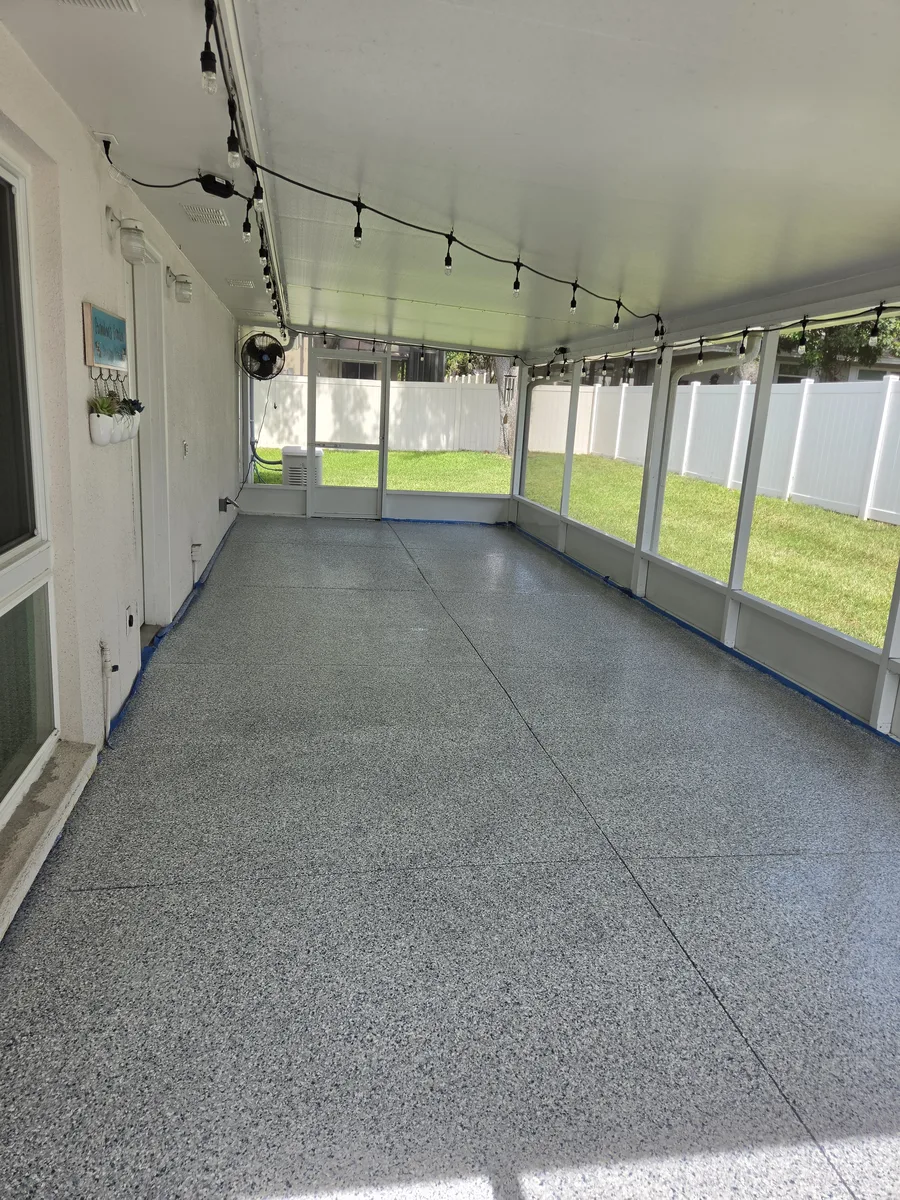
Metallic epoxy vs flake epoxy: which floor is right for a Florida home?
For most Florida garages, a full-broadcast flake epoxy floor is the right pick. Metallic epoxy is the right pick for interior rooms and showpiece spaces. Flake hides dirt and tire marks, adds grip from its texture and costs less. Metallic gives a glossy, one-of-a-kind look, but it shows scratches and does best in a shaded, dry room.
We install both systems across Pinellas, Hillsborough and Pasco counties and the city of Sarasota. This guide compares them room by room. If the glossy look is what you want, start with our metallic epoxy floors page. Then come back here for the trade-offs.
What is the difference between metallic epoxy and flake epoxy?
Flake epoxy is a pigmented base coat with vinyl flakes broadcast into it. The flakes cover the whole coat, and a clear topcoat locks them in. Metallic epoxy is a clear epoxy mixed with metallic pigment. It is spread out and worked while wet to create the swirls. One is textured and speckled; the other is smooth and glossy.
GarageFloorCoating.com describes a full-flake job in three steps. A primer goes down first. Then a color coat gets flakes broadcast until they fully cover it. One or more clear topcoats finish the system, which can reach up to 30 mils thick.
Duraamen, a coating maker, lists metallic as a three-step process: prime, apply and seal. The effects come from a solvent spritz or a second color worked into the wet coat. A polyaspartic topcoat finishes the floor. Our flake system flooring follows the same full-broadcast build, with a polyaspartic or urethane topcoat.
Which one holds up better in a Florida garage?
Flake wins in a garage. The flake texture gives more grip than a smooth resin floor. The speckled pattern hides dust, sand and tire marks. A metallic floor is high gloss, so scratches and grit show quickly. It also gets slick when wet or oily. For a floor that sees cars every day, flake is the practical choice.
Epoxy Plus notes that full-broadcast flake floors are the most popular garage choice because the flake itself adds texture. Epoxy Flooring Professional flags the opposite problem with metallic: the high-gloss finish scratches easily, and the floor gets very slippery when wet or covered in oil. That is a poor match for a garage that sees rain-soaked tires most summer afternoons.
Heat matters too. Hello Garage reports tires can reach upwards of 140 degrees in summer. That heat can weaken a coating’s bond with the slab. All Garage Floors traces most hot-tire pickup to cheap water-based epoxy that re-softens under heat. Weak prep is the other cause. We diamond grind every slab before coating so the base coat bites into the concrete. Our garage systems get a polyaspartic or urethane topcoat.
How do Florida humidity and sun affect each floor?
Sun is the bigger split between the two. Plain epoxy ambers under UV light. A metallic floor is mostly clear epoxy, so a sunlit room can shift its color over time. In a flake floor the flakes cover the color coat, and a UV-stable topcoat seals it. Humidity matters for both, so we moisture test before quoting.
Coating supplier Zeraus puts it plainly: there is no such thing as a UV-resistant epoxy. Stabilizers only delay the change. The same page lists polyaspartic and aliphatic polyurethane among the coatings that do not absorb UV light. Coated Local’s hot-climate guide says standard epoxy yellows in a band where the sun hits. It calls that the most common complaint on otherwise sound Florida installs. World Population Review ranks Florida fourth among states for annual UV irradiance. A metallic floor belongs away from big west-facing windows.
Moisture is the other Florida factor. Coated Local notes that Florida slabs regularly push more vapor than standard coatings tolerate. The usual limit is 3 lbs per 1,000 square feet per day, and high water tables push slabs past it. A slab over that limit needs a moisture-tolerant primer or a different plan. That is why we run moisture tests before we quote a system, on metallic and flake jobs alike.
Which floor hides dirt, wear and scratches better?
Flake hides more. Peckham Coatings notes a flake finish hides scuffs and minor wear better than a solid color. The same goes for sand tracked in from the driveway. Metallic is a deep gloss, so fine scratches and dust stand out. Epoxy Flooring Professional warns it is almost impossible to touch up. In a family garage, that matters.
There is one more catch with metallic. The clear epoxy makes flaws in the concrete visible, from old cracks to patched spots. We repair cracks and spalls before any coating, but a metallic floor still asks more of the slab underneath. A flake floor covers those repairs completely.
What do metallic and flake epoxy floors cost in Florida?
Metallic costs more in most published ranges. This Old House and Bob Vila both list metallic epoxy at $5 to $12 per square foot installed. HomeGuide puts standard epoxy floors at $4 to $10 per square foot. Decorative flakes add $0.50 to $2.00 in HomeGuide’s data. A real number for your floor needs an on-site look.
| System | Published installed range | Source |
|---|---|---|
| Standard epoxy floor | $4–$10 per sq ft | HomeGuide |
| Epoxy floor, professional install | $3–$12 per sq ft | This Old House |
| Metallic epoxy floor | $5–$12 per sq ft | This Old House, Bob Vila |
| Decorative flake add-on | $0.50–$2.00 per sq ft | HomeGuide polyaspartic cost guide |
| Polyaspartic-topped system | $5–$12 per sq ft | HomeGuide |
| Epoxy floor, 2-car garage total | $1,600–$5,800 | HomeGuide |
Prep moves the price more than the pigment does. HomeGuide lists moisture testing at $50 to $300. It puts concrete resurfacing at $3 to $7 per square foot when a slab is badly damaged. Bigger floors usually cost less per square foot. For what drives the metallic number, read our post on metallic epoxy floor cost in Florida.
Which one is harder to install?
Metallic is the harder install. The pigment effects are made while the epoxy is wet, so the pattern is set in one pass. It cannot be redone later. Floor Shield Coatings says a metallic job keeps the space out of use for about a week. A flake floor is more forgiving because the broadcast covers the base coat fully.
Every metallic floor is unique because the swirls form as the wet coat moves. That is the appeal, and it is also the risk. A rushed spread or a bad slab shows in the finished floor. Flake installs are steadier work: grind, repair, base coat, broadcast to full coverage, scrape, then topcoat. Our post on full-broadcast flake flooring walks through each step.
Which look fits which room?
Metallic fits interior rooms and showpiece spaces: a living area, a den or a garage used as a showroom. Flake fits working floors: garages, laundry rooms and workshops. With a UV-stable topcoat it also fits patios and lanais. Peckham Coatings lists retail showrooms and dealership floors among flake’s commercial homes. Flake shows up in plenty of commercial spaces too.
Either floor reads as an upgrade to a buyer. Flake reads as a finished, easy-care garage. Metallic reads as a designer floor. Pick the one that matches how the room gets used. Then pick colors that hide what that room collects. Our guide on how to choose flake colors covers the second part.
| Factor | Metallic epoxy | Full-broadcast flake epoxy |
|---|---|---|
| Look | Smooth, deep gloss, one-of-a-kind swirls | Speckled, textured, uniform |
| Grip | Slick when wet or oily | Texture from the flake adds grip |
| Hides dirt and wear | Shows scratches, dust and slab flaws | Hides scuffs, sand and minor wear |
| Sun exposure | Can shift color in sunlit rooms | Flakes cover the color coat, UV-stable topcoat |
| Best rooms | Interiors, showrooms, dens | Garages, laundry rooms, patios, lanais |
| Install | Pattern set in one pass, about a week | Steady multi-step build |
| Published cost | $5–$12 per sq ft (This Old House, Bob Vila) | $4–$10 base plus $0.50–$2.00 flakes (HomeGuide) |
Want to see both on your own slab? Request a free on-site quote through our metallic epoxy service page or call (727) 423-5985. We check the concrete, test for moisture and price the system that fits the room.