
Pavers vs concrete patio in Florida: which is better?
Concrete wins on price, and pavers win on repairs. HomeGuide’s paver patio guide says pavers cost about twice as much as laying concrete. If a sound slab already sits behind your house, coating it is a third option worth pricing.
We are a Pinellas County crew. We coat existing concrete patios across Pinellas, Hillsborough and Pasco counties, plus the city of Sarasota. We do not install pavers or pour concrete, since other trades do that work.
Every paver and new slab figure below comes from a published cost guide. HomeGuide runs a separate guide for each project, so each figure names its guide. Our concrete patio coatings are the third option in this post.
Paver patio vs concrete: which costs more?
Concrete costs less up front. HomeGuide’s paver patio guide says installing pavers costs $10 to $17 per square foot. HomeGuide’s paver patio guide puts a concrete slab at $4 to $8 per square foot.
HomeGuide’s concrete patio guide prices concrete differently, so read each figure against its own guide. HomeGuide’s concrete patio guide says a plain concrete patio costs $4 to $12 per square foot installed. In HomeGuide’s concrete patio guide, a basic 20x20 concrete patio costs $1,600 to $4,800. HomeGuide’s concrete patio guide says rebar or wire mesh adds $1 to $3 per square foot and helps prevent cracking.
On the paver side, HomeGuide’s paver patio guide puts the average brick paver patio at $1,900 to $6,800 total. That total is not tied to one patio size, so compare per square foot first.
| Patio option | Published cost per square foot | Source |
|---|---|---|
| Concrete slab | $4 to $8 | HomeGuide paver patio guide |
| Pavers, installed | $10 to $17 | HomeGuide paver patio guide |
| Plain concrete patio, installed | $4 to $12 | HomeGuide concrete patio guide |
| Broom-finished concrete patio | $6 to $13 | HomeGuide concrete patio guide |
| Stained or stamped concrete patio | $8 to $30 | HomeGuide concrete patio guide |
| Coating an existing slab | $4 to $12 | HomeGuide concrete patio guide |
| New slab plus coating | $7 to $22 | HomeGuide concrete patio guide |
Your site and finish move every one of these numbers. A real price needs an on-site look at the slab.
Concrete patio vs pavers: which lasts longer?
Both last for decades when the base under them is built right. HomeGuide’s concrete patio guide says a properly installed concrete patio lasts 30 to 50 years with regular maintenance. HomeGuide’s concrete patio guide also lists paver patios at 25 to 75 years.
The base decides where a patio lands in those ranges. HomeGuide’s driveway pavers guide warns that pavers can sink or crack over a poorly graded surface. HomeGuide’s paver patio guide says edging holds pavers in place, or they slowly shift and gaps open around the edges.
A coating rides on the slab under it. HomeGuide’s concrete coating guide lists polyaspartic coatings at 10 to 20-plus years. A worn coating gets ground back to sound concrete and rebuilt.
What happens when a paver or a concrete slab cracks?
Repairs are where pavers pull ahead. HomeGuide’s paver patio guide says pavers are easier to repair, and concrete slabs are more affordable.
A sunken patch of pavers can be lifted out and reset. A slab cracks as one piece, and Fixr notes that concrete may need patching over time. HomeGuide’s driveway pavers guide adds that a replaced section of slab probably won’t match in color.
On a coating job, crack repair is part of the prep. We diamond grind the slab, then fill cracks and rebuild spalled edges before any coat goes down. A slab that is still moving is a different case, and we say so at the quote.
How does Florida’s rainy season treat pavers and concrete?
Rain is the big local test. The National Weather Service (NWS) office in Tampa Bay tracks the rainy season. NWS Tampa Bay says it runs from May 25 to October 10 for most of West Central Florida. The NWS describes those months as warm and humid, with frequent showers and thunderstorms.
Pavers let some of that water through. HomeGuide’s driveway pavers guide counts pavers as permeable to rainwater, which it says prevents water pooling. The joints need care in return, and Fixr says pavers may need occasional replacement or repacking of joint material.
HomeGuide’s driveway pavers guide says to keep topping up joint sand, or pavers start moving side to side. Humid months also bring mildew. HomeGuide’s paver sealing guide says crews pressure clean dirt and mildew off pavers before sealing them.
Bare concrete has no joints, but it is porous and soaks up stains. A coated slab is one sealed surface with nothing for rain to wash out.
Which patio gets hotter underfoot?
Color plays a big part. Fixr warns that dark materials, dark pavers included, absorb heat and make a pool deck very hot to the touch. Fixr also says a heat-reflective material keeps the deck surface cooler on hot days.
On a coated patio, the flake blend sets the color. A lighter blend is the pick for a patio in full sun.
Sun also yellows some coatings. HomeGuide’s concrete coating guide says epoxy is more prone to cracking and UV damage. That is why every outdoor system we install finishes with a UV-stable topcoat.
Which patio is less slippery when wet?
Texture and sealer decide grip. HomeGuide’s paver patio guide says pavers are not slippery unless sealed. HomeGuide’s paver sealing guide lists “can be slippery” as a downside of solvent-based sealers.
Smooth concrete is the slick one. Fixr says a concrete deck can become slippery when wet if it is left smooth. HomeGuide’s concrete patio guide says a broom finish gives better slip resistance than smooth concrete.
Our patio coatings get anti-slip texture tuned for wet areas. We can run it heavier by the pool and lighter under a roof. Our non-slip coating options page shows how the texture gets chosen.
How much upkeep does each patio need?
Pavers need the most routine care. HomeGuide’s paver patio guide puts sealing at $1.50 to $3.25 per square foot, including pressure washing and refilling joint sand. HomeGuide’s paver sealing guide says paver sealing lasts 3 to 5 years, depending in part on local climate and humidity.
Weeds are the other chore. Fixr says weeds may grow between pavers, and that a concrete slab avoids the problem. HomeGuide’s paver patio guide says polymeric joint sand hardens and doesn’t let weeds take root.
Plain concrete needs less work, though bare concrete stains. HomeGuide’s concrete coating guide puts concrete sealing at $1 to $3 per square foot installed. HomeGuide’s concrete coating guide says sealers form a very thin layer that only protects against water or stains.
A coated patio gets a hose rinse or a push broom. HomeGuide’s concrete coating guide says coatings can last for many years without having to reapply or reseal.
Can you put pavers over a concrete patio?
Yes, if the slab is in good shape. HomeGuide’s driveway pavers guide says pavers can go over sound concrete once cracks, chips and holes are repaired.
HomeGuide’s driveway pavers guide notes that some manufacturers make thinner pavers built to overlay concrete. Any pavers set on top still raise the patio. Check the sliding door threshold and where rain drains off before you commit. A slab in good enough shape for pavers is also a good candidate for a coating.
What does a concrete patio coating involve?
Coating keeps the slab you already have and changes its surface. HomeGuide’s concrete patio guide says epoxy coatings offer superior durability and waterproofing compared to standard concrete paint.
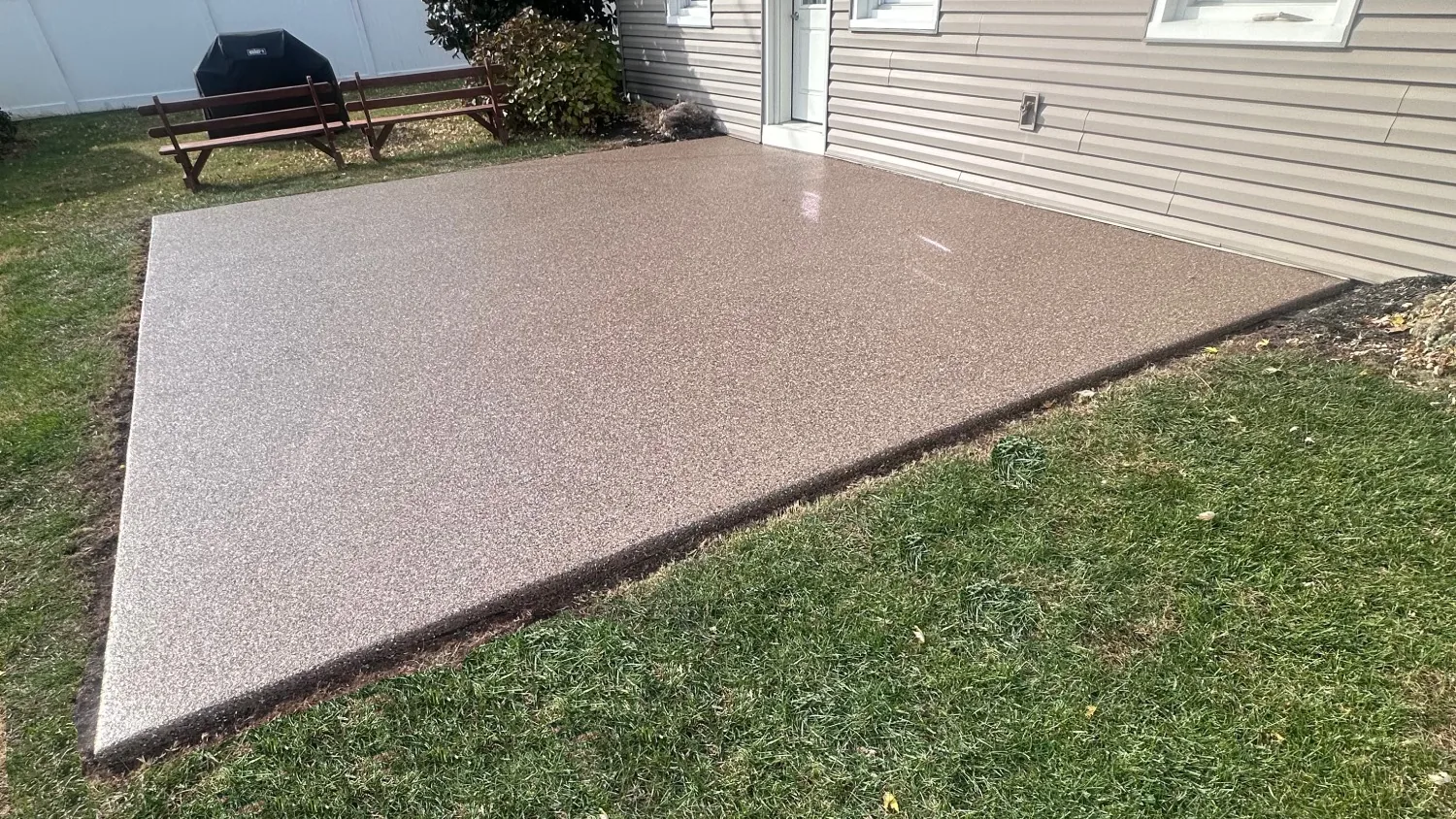
It is the same build we use on every patio and pool deck coating. We diamond grind the slab and repair cracks and spalls. We moisture test it before we quote. Next, an epoxy or polyurea base coat goes down.
We broadcast flake into the base coat until it covers the whole floor, which makes it a full-broadcast flake coating. A UV-stable polyaspartic topcoat seals the flake, with anti-slip texture tuned for wet areas. The quote lists every coat, and we give you the cure timeline at the quote.
A covered patio is a lanai in Florida, and the same build goes under the roof. Screened and covered slabs fall under our lanai floor coating service.
A Google review of our work reads: “Great company! Had my family’s patio done. Fast, detailed and affordable!”
Coating is the wrong call for a slab that is breaking up or still settling. In that case, pavers or a new pour from another trade make more sense.
How do pavers, plain concrete and a coated slab compare?
Each figure names its source. Read the coated slab column as our flake build on a sound, existing slab.
| Factor | Pavers | Plain concrete patio | Coated concrete slab |
|---|---|---|---|
| Published cost | $10 to $17 per square foot installed (HomeGuide paver patio guide) | $4 to $12 per square foot installed (HomeGuide concrete patio guide) | $4 to $12 per square foot on an existing slab (HomeGuide concrete patio guide) |
| Lifespan | 25 to 75 years (HomeGuide concrete patio guide) | 30 to 50 years (HomeGuide concrete patio guide) | Polyaspartic coatings 10 to 20-plus years (HomeGuide concrete coating guide) |
| Heat underfoot | Fixr: dark pavers get very hot to the touch | Fixr: a concrete deck stays relatively cool to the feet when wet | Flake color sets it; Fixr says heat-reflective material stays cooler |
| Weeds and joints | Fixr: weeds may grow between pavers, and joints may need repacking | Fixr: a concrete slab avoids weeds between units | One sealed surface with no joints |
| Repairs | Single pavers lift out and reset (HomeGuide: easier to repair) | Fixr: concrete may need patching if it cracks | Cracks and spalls repaired before coating |
| Upkeep | Sealing at $1.50 to $3.25 per square foot (HomeGuide paver patio guide), lasting 3 to 5 years (HomeGuide paver sealing guide) | Sealing at $1 to $3 per square foot (HomeGuide concrete coating guide) | Hose rinse or push broom |
| Grip when wet | HomeGuide: not slippery unless sealed | HomeGuide: a broom finish grips better than smooth | Anti-slip texture tuned for wet areas |
Which should you pick for a Florida patio?
Pick pavers if you want units you can lift and reset, and the budget allows. HomeGuide’s paver patio guide also claims pavers provide a 69% return on investment.
Pick a new concrete patio if there is no slab yet and price comes first. HomeGuide’s concrete patio guide says plain concrete can serve as the foundation for future decorative treatments. A coating can go on later.
Pick a coating if a sound slab already sits behind the house. You keep the concrete you have and get a sealed, textured surface on top. If your patio wraps a pool, read how pool deck resurfacing options compare.
Want a real number for your patio? We give free on-site quotes across Pinellas, Hillsborough and Pasco counties, plus the city of Sarasota. Call (727) 423-5985, and we will check the slab and test it for moisture before we price it.