
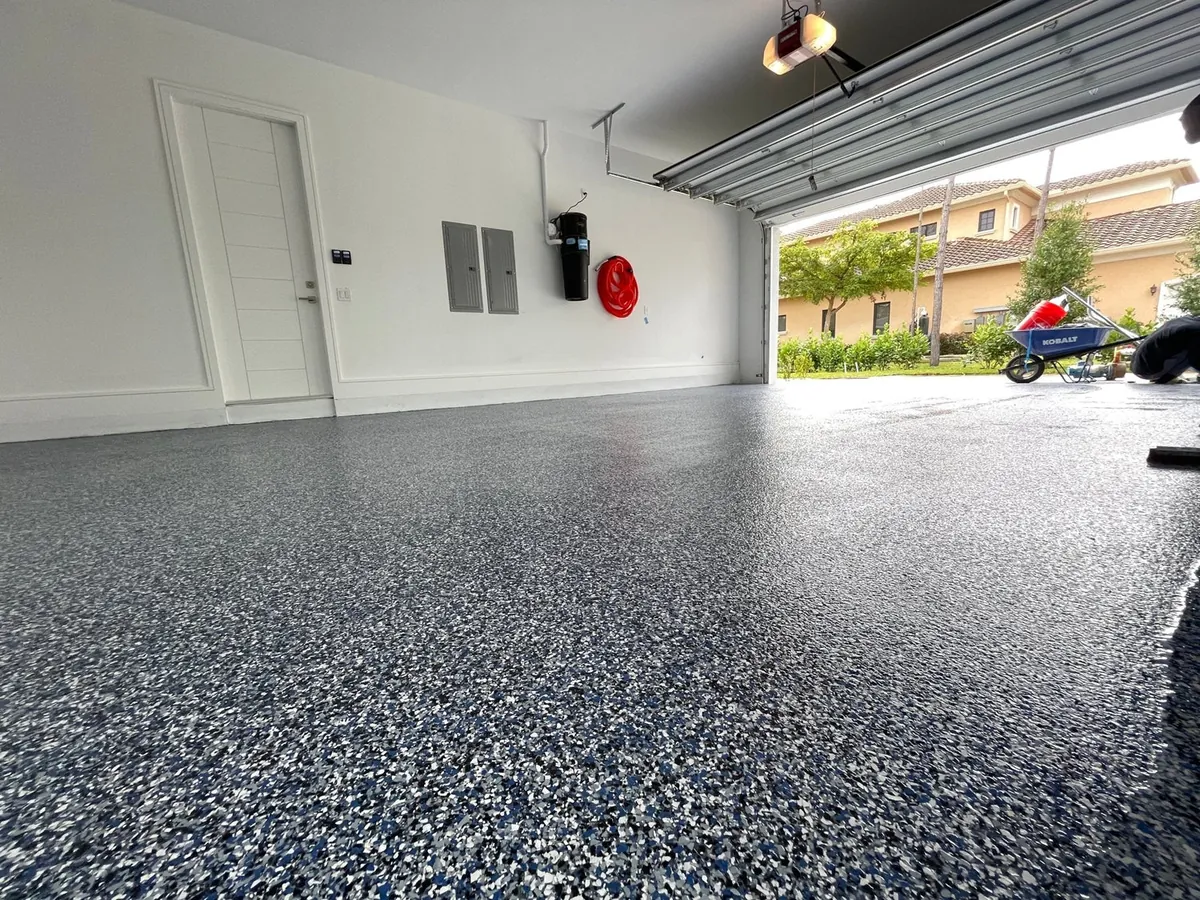
Polyurea vs polyaspartic floor coating: which is better for a Florida floor?
Polyaspartic is a type of polyurea, so the real choice is between fast-set spray polyurea and polyaspartic. Spray polyurea goes on through a spray rig, and most of it is the aromatic kind that fades in sunlight. Polyaspartic rolls on and holds its color outdoors, so it makes the better wear coat on a Florida floor.
We install polyaspartic floor coating across Pinellas, Hillsborough and Pasco counties, plus the city of Sarasota. Most of our installs are hybrid systems, with an epoxy or polyurea base coat under a polyaspartic wear coat. Each material does a different job in that stack, and the chemistry explains why.
Is polyaspartic a type of polyurea?
Yes. Polyaspartic is an aliphatic polyurea made from polyaspartic ester resins. A technical paper given at the Polyurea Development Association’s 2004 annual conference, held in Tampa, lays out the family tree. That PDA paper says the association published its definition of polyurea in 2000.
Under that definition, one of the two parts in a polyurea can be aromatic or aliphatic. Those words describe the backbone of the chemistry. On a floor, the difference shows up mostly in sunlight.
The PDA paper says polyaspartic ester polyurea arrived in the early 1990s. It was made mainly for thin films, where high gloss and color stability matter. PCI Magazine credits Covestro with inventing polyaspartic resins, which carried polyurea into thin-film coatings.
The name still causes mix-ups. The PDA paper describes major confusion over what counts as a polyurea. Some people doubted the newer systems counted at all, since they skip the high-pressure plural component spray equipment. So a quote that says “polyurea” can mean a sprayed product or a rolled one.
How do spray polyurea and polyaspartic go on a floor?
Spray polyurea is built for speed. The PDA paper says two-component polyurea typically dries in less than 30 seconds. It runs through specialized plural component equipment that develops high pressure and high temperature for spraying. The two parts meet inside the spray gun itself.
PCI Magazine says two-component aromatic polyurea coatings were first used as spray-in truck bedliners. The PDA paper names the big payoff of that speed: a structure goes back into service very quickly.
Polyaspartic works at a slower pace. The PDA paper calls polyaspartic ester polyurea a slow dry technology, with dry times of up to 120 minutes. The paper says it can go on by brush or roller.
Working time on a polyaspartic coat is counted in minutes. Deco-Crete Supply’s data sheet for one polyaspartic topcoat lists a pot life of 15 to 20 minutes. That sheet says pot life shrinks as the batch gets bigger and the temperature rises. A hot Florida garage shortens that window.
What does Florida sun do to polyurea and polyaspartic?
Sunlight is where the two split. The PDA paper says all aromatic two-component polyurea systems fade or change color in ultraviolet light. The paper calls this a surface effect on the polymer. Even with UV stabilizers, the PDA paper says aromatic systems discolor and fade over time in light colors outdoors.
Aliphatic polyurea has excellent resistance to UV degradation, according to the same PDA paper. Polyaspartic was built for color stability from the start. So a floor that sees daylight wants an aliphatic wear coat on top.
On our outdoor work, the topcoat is a UV-stable polyaspartic or urethane. That goes for our lanai floor coatings and our driveway and walkway coatings. We also tune an anti-slip texture for wet areas, since a smooth gloss coat can get slick.
How do humidity and a damp slab affect each one?
Moisture in the air and moisture in the slab are two different problems. The PDA paper says the fast reaction of spray polyurea is virtually unaffected by moisture in the air. Polyaspartic is touchier. PCI Magazine lists cure time affected by humidity as a drawback of two-component polyaspartic coatings.
Data sheets set limits as well. Deco-Crete Supply’s sheet says not to apply its polyaspartic topcoat when relative humidity exceeds 85 percent. For most of West Central Florida, the rainy season runs May 25 to October 10, says the National Weather Service. That is a long, wet stretch for a coating that reacts to humidity.
The slab matters even more. The PDA paper says polyurea will react over water but will not bond to the surface in that spot. The PDA paper also says the slab’s temperature must be 5 degrees above the dew point and rising. Below that, moisture condenses on the concrete and the bond suffers.
Polyaspartic is a polyurea, so the same rule holds. Deco-Crete Supply’s data sheet requires a concrete moisture test before its polyaspartic goes down. That is why we moisture test the slab before we quote.
How do spray polyurea and polyaspartic compare side by side?
Each row names its source. Both columns describe the material on its own, outside a full floor system.
| Question | Fast-set spray polyurea | Polyaspartic |
|---|---|---|
| Chemistry | Mostly aromatic, the workhorse type in the PDA paper | Aliphatic polyurea made from polyaspartic ester resins |
| How it goes on | Plural component spray rig with high pressure and heat (PDA paper) | Brush or roller, or premixed and sprayed airless (PDA paper) |
| Set or dry time | Typically less than 30 seconds (PDA paper) | Slow dry, up to 120 minutes (PDA paper) |
| Pot life | The two parts mix inside the spray gun (PDA paper) | 15 to 20 minutes for one topcoat (Deco-Crete Supply) |
| Sunlight | Fades or changes color in UV light (PDA paper) | Resists UV degradation as an aliphatic (PDA paper) |
| Humid air | Reaction virtually unaffected (PDA paper) | Cure time affected by humidity (PCI Magazine) |
| Wet slab | Reacts over water but will not bond there (PDA paper) | Needs a concrete moisture test first (Deco-Crete Supply) |
| First big use | Spray-in truck bedliners (PCI Magazine) | Thin films where gloss and color stability matter (PDA paper) |
Spray polyurea wins on raw speed and on tolerance for humid air. Polyaspartic wins on color in the sun and on time to work the coat. For a floor that sees daylight, that second win decides it.
Where do polyurea and polyaspartic go in our floor systems?
Our coating systems go down in layers. We diamond grind the slab and repair cracks and spalls. The slab gets a moisture test before we quote. In a hybrid system, the base coat is epoxy or polyurea, and a polyaspartic wear coat goes on top.
On a full-broadcast flake floor, flake goes into the base coat to full coverage before the wear coat seals it. That flake floor is the most popular finish on our garage floor epoxy jobs. Where downtime matters most, we run polyaspartic through the whole system. The quote lists the coats, so you can see what goes down.
Epoxy shows up here only as a base coat option. For that matchup, read epoxy vs polyaspartic in Florida.
What do polyurea and polyaspartic floor coatings cost?
HomeGuide publishes cost ranges for both coatings on garage floors. A real price for your floor needs an on-site look.
| Coating | HomeGuide cost per square foot | HomeGuide total for a two-car garage |
|---|---|---|
| Polyurea garage floor coating | $5 to $10 | $2,000 to $5,800 |
| Polyaspartic garage floor coating | $5 to $12 | $2,000 to $6,900 |
HomeGuide says polyurea and polyaspartic coatings typically last 10 to 20 years or more. A floor that lasts that long spreads its cost over many years.
Square footage moves the number, and so does the repair work your slab needs. We price the system after we see and test the slab. For more on the money side, read what polyaspartic costs in Florida.
How long before you can walk or park on each one?
A fast reaction and a fast floor are two different things. HomeGuide says polyurea coatings can be ready for foot traffic in 1 to 2 days. HomeGuide adds that you may need to wait 3 days before driving on it. HomeGuide says polyaspartic can often be installed and fully cured within 1 day, though some jobs require 2 days.
Product data sheets vary too. Deco-Crete Supply lists light traffic at 24 hours and vehicle traffic at 7 days for its standard-set polyaspartic topcoat. The product and the weather both move the clock.
We give you the cure timeline at the quote. For more on cure times, see how long before you can walk or park on a coated floor.
Which one should you pick for a Florida floor?
For most Florida floors, the answer is a system with polyaspartic on top. Anything that sees daylight wants an aliphatic wear coat, and polyaspartic fills that role. When the floor cannot sit closed for long, polyaspartic can run through the whole system.
If a quote just says “polyurea,” ask how it goes on and whether it is aromatic or aliphatic. Then ask what goes on top, and when you can drive on it.
A Google review of our work reads: “Great company! Had my family’s patio done. Fast, detailed and affordable!”
Want a real number for your floor? We give free on-site quotes across Pinellas, Hillsborough and Pasco counties and the city of Sarasota. Call (727) 423-5985. We moisture test the slab and price the system it needs, and the quote lists every coat.