
Epoxy vs polyurea floor coating: which is better for a Florida garage?
For most Florida garages, the best floor layers an epoxy or polyurea base coat under a polyaspartic wear coat. Epoxy builds a thick base for a little less money and gives the crew more working time. Spray polyurea sets fast through a heated rig, but the common aromatic kind fades in sunlight.
We coat garage floors across Pinellas, Hillsborough and Pasco counties, plus the city of Sarasota. Our garage floor epoxy work starts with diamond grinding and crack and spall repair. Every figure below names its publisher, and a real price for your floor needs an on-site look.
What is the difference between epoxy and polyurea?
Both are two-part coatings that harden by chemical reaction. Bob Vila describes epoxy flooring as a thermosetting epoxide resin and a polyamine hardener.
Polyurea is two parts as well, an isocyanate side and a resin blend. A Polyurea Development Association (PDA) conference paper lays out the chemistry. It says the aromatic kind has been the workhorse of two-component polyurea, and that aromatic refers to the chemical backbone.
That backbone matters in Florida. PCI Magazine sorts polyurea and polyurethane hardeners into two groups: aromatic, which yellows, and aliphatic, which is light stable. Polyaspartic falls on the aliphatic side, and Concrete Network calls it a type of polyurea. Our polyurea vs polyaspartic comparison covers that matchup.
The label covers a wide range of products. The PDA paper notes that some newer polyurea systems skip the high-pressure plural component equipment. So a quote that says “polyurea” can mean a sprayed coat or a hand-applied one.
How do epoxy and polyurea go on a floor?
Spray polyurea is built for speed. The PDA paper says two-component polyurea typically dries in less than 30 seconds. It runs through specialized plural component equipment that develops high pressure and high temperature. The two parts mix inside the spray gun itself.
PCI Magazine says aromatic polyurea was first used for spray-in truck bedliners. PCI Magazine also says a smooth finish is difficult to get with it. The same PCI Magazine list warns that speed can limit adhesion.
Not every floor polyurea moves that fast. Concrete Network says a polyurea floor coating can harden in as little as 10 minutes. Concrete Network adds that the fast cure leaves little room for error.
Epoxy gives the crew more time. Bob Vila says some installers use a roller to apply epoxy, while others use a squeegee or a trowel. Concrete Network credits epoxy with longer working times. It also says epoxy can be applied thickly enough to hide minor imperfections in concrete.
How do a damp slab and Florida humidity affect each one?
Moisture in the air and moisture in the slab are two different problems. The National Weather Service says the rainy season runs May 25 to October 10 for most of West Central Florida. That is a long, wet stretch for any coating job.
Humid air barely slows spray polyurea. The PDA paper says its fast reaction is virtually unaffected by moisture in the air. The PDA paper says polyurea will react over water, but it will not bond to the slab in that spot.
Dew point sets the timing for both. The PDA paper says the slab’s temperature must be 5 degrees above the dew point and rising. Below that, moisture condenses on the concrete and the bond suffers. The PDA paper says that holds for other coating systems too.
Epoxy gets no pass on a damp slab either. Bob Vila says solid epoxy is not recommended for high-moisture areas. Concrete Network warns that vapor rising from a damp slab can get trapped under a polyurea coat. That is why we moisture test the slab before we quote.
What does Florida sun do to epoxy and polyurea?
Sunlight splits the field. HomeGuide says epoxy coatings are more prone to cracking and UV damage. The PDA paper says aromatic polyurea fades over time in light colors outdoors, even with UV stabilizers. The same PDA paper says aliphatic polyurea has excellent resistance to UV degradation.
Cost guides blur this line. HomeGuide credits polyurea with outstanding UV protection. Concrete Network says polyureas are vulnerable to UV exposure and can discolor in a sunlit garage. Both can be true, because the aromatic and aliphatic kinds behave very differently in the sun.
Concrete Network advises a UV-resistant polyaspartic topcoat on any garage floor exposed to direct sunlight. On our outdoor floors, the topcoat is a UV-stable polyaspartic or urethane.
Which one holds up better to hot tires and hard use?
Hot tire pickup is when a coat lifts off the slab where a parked car’s hot tires cool. It shows up on thin films and on slabs that were never ground properly. Concrete Network says epoxy and the newer polyurea coatings both give excellent resistance to hot tire marks.
Flexibility is where polyurea pulls ahead. Concrete Network says polyurea keeps its flexibility after curing, which gives it high impact resistance. HomeGuide says epoxy is not as strong as polyurea or polyaspartic coatings.
Fast-set polyurea has its own risk on a slab. The PDA paper says some shrinkage occurs as polyurea cures. The PDA paper warns those forces may be strong enough to curl the corners or edges of the work.
The top layer matters as much as the base. An expert quoted by Concrete Network says a clear polyaspartic topcoat improves hot tire resistance and UV stability. The same expert says a high percentage of coating failures come from poor surface prep. We diamond grind the slab instead of acid etching it, and we repair cracks and spalls first.
What do epoxy and polyurea floor coatings cost?
HomeGuide puts an epoxy garage floor at $4 to $10 per square foot. For a 2-car garage, HomeGuide totals epoxy at $1,600 to $5,800, materials and labor included.
HomeGuide prices polyurea garage floor coating at $5 to $10 per square foot. HomeGuide puts an average 2-car garage in polyurea at $2,000 to $5,800. HomeGuide calls epoxy slightly cheaper than polyurea and polyaspartic, though not as durable.
The two ranges overlap a lot. HomeGuide says labor often makes up about 50 to 70 percent of the total project cost. HomeGuide also says a bigger garage and slab repairs add to the price. A real number for your floor needs an on-site look.
How long does each one last, and when can you park on it?
Bob Vila says epoxy flooring typically lasts 10 to 20 years when it is properly maintained. HomeGuide says polyurea and polyaspartic coatings typically last 10 to 20 years or more. Concrete Network says a properly installed polyurea or polyaspartic coating is likely to outlast an epoxy coating.
Return to service is where polyurea wins clearly. HomeGuide says polyurea coatings can be ready for foot traffic in 1 to 2 days. HomeGuide adds that you may need to wait 3 days before driving on it.
Epoxy takes longer. HomeGuide says epoxy coatings take about 2 days to install but may take up to a week to cure. Concrete Network says you can walk on an epoxy floor after 24 hours.
A fast set is not the same as a full cure. The PDA paper says polyurea can set fast enough to reopen a floor early. The PDA paper also says it may not reach its full physical properties for 24 hours or more. We give you the cure timeline at the quote.
How do epoxy and polyurea compare side by side?
Each row names its source. Both columns describe the material on its own, outside a full floor system.
| Question | Epoxy | Polyurea |
|---|---|---|
| How it goes on | Roller, squeegee or trowel (Bob Vila) | Plural component spray rig with high pressure and heat (PDA paper) |
| Set speed | Longer working times (Concrete Network) | Less than 30 seconds sprayed (PDA paper); as little as 10 minutes for some floor coats (Concrete Network) |
| Damp slab | Solid epoxy not recommended for high-moisture areas (Bob Vila) | Reacts over water but will not bond there (PDA paper) |
| Humid air and dew point | Condensation hurts the bond, as with other coatings (PDA paper) | Humid air barely slows it; slab 5 degrees above the dew point and rising (PDA paper) |
| Florida sun | More prone to cracking and UV damage (HomeGuide) | Aromatic fades in light colors outdoors; aliphatic resists UV (PDA paper) |
| Hot tires and impact | Excellent resistance to hot tire marks (Concrete Network) | The same, and it stays flexible for high impact resistance (Concrete Network) |
| Cost per square foot | $4 to $10 (HomeGuide) | $5 to $10 (HomeGuide) |
| 2-car garage total | $1,600 to $5,800 (HomeGuide) | $2,000 to $5,800 (HomeGuide) |
| Lifespan | 10 to 20 years when properly maintained (Bob Vila) | 10 to 20 years or more (HomeGuide) |
| Return to service | Walk after 24 hours (Concrete Network); up to a week to cure (HomeGuide) | Foot traffic in 1 to 2 days; driving may wait 3 days (HomeGuide) |
Polyurea wins on speed and flexibility. Epoxy wins on working time and a slightly lower price. Neither one fixes a damp slab, and the sun row depends on which kind of polyurea you get.
Why do pro garage floors combine them?
Each chemistry covers a gap in the other. Concrete Network says some installers combine systems to get the best qualities of each. Concrete Network names the base as a self-leveling epoxy or a 100 percent solids polyurea, tinted for color chips. A clear polyaspartic topcoat goes over it.
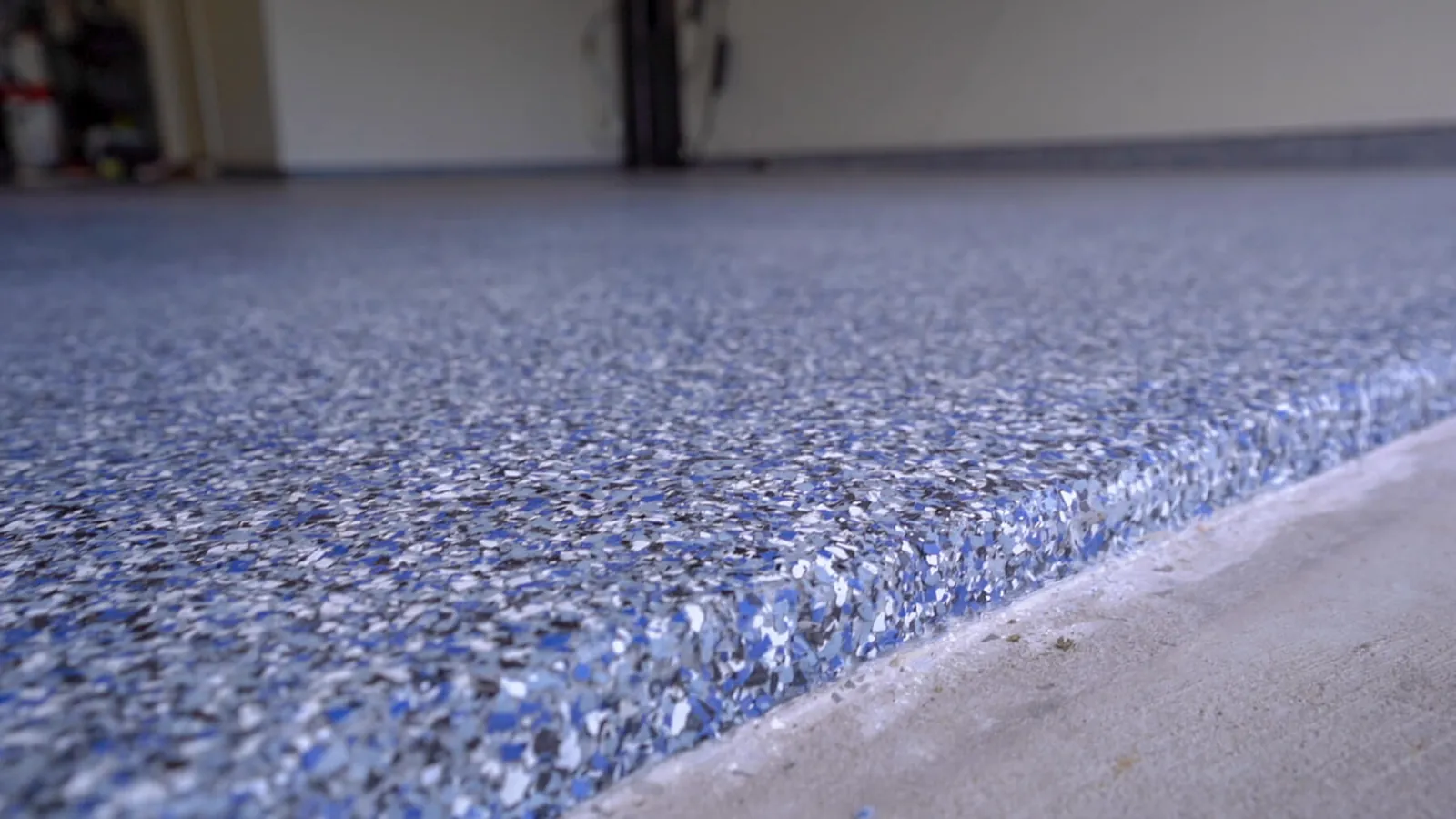
Most of our installs are hybrid systems: an epoxy or polyurea base coat under a polyaspartic wear coat. A full-broadcast flake floor is the most popular garage finish we install. Flake goes into the wet base coat to full coverage, and the polyaspartic wear coat seals it.
The quote lists the coats, so you can see which base goes down on your slab. For the topcoat side of the choice, read epoxy vs polyaspartic in Florida.
What should you ask about an epoxy or polyurea quote?
A quote that only says “polyurea” or “epoxy” leaves out the parts that matter. Bob Vila lists moisture testing among the questions to ask an installer. Ask these about any Florida garage quote:
- Is the polyurea sprayed with a plural component rig, or rolled on by hand?
- Is it aromatic or aliphatic, and what goes on top of it?
- Was the slab moisture tested, and what did it read?
- When can you walk on it, and when can you park on it?
Which should you pick for a Florida garage?
For most garages here, a hybrid system beats any one material on its own. The base coat carries the build and the flake, and a polyaspartic wear coat takes the sun and the tires.
The same thinking applies to shops and commercial floors, where downtime costs money. The PDA paper calls a quick return to service the big advantage of polyurea.
A Google review of our work reads: “Great company! Had my family’s patio done. Fast, detailed and affordable!”
Want a real number for your floor? We give free on-site quotes across Pinellas, Hillsborough and Pasco counties and the city of Sarasota. Call (727) 423-5985. We moisture test the slab and price the system it needs, and the quote lists every coat.