
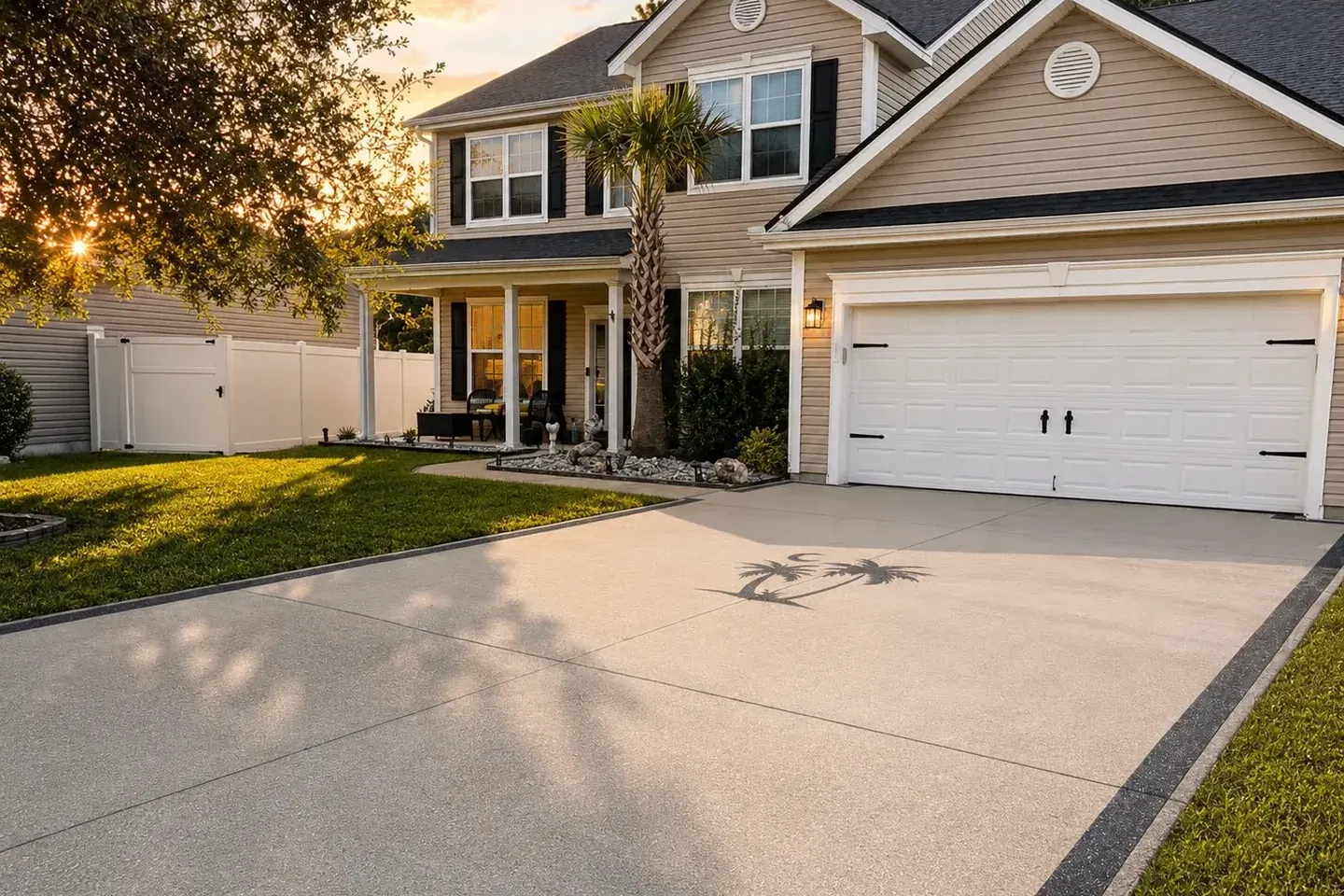
Pavers vs concrete driveway in Florida: which is better?
Concrete costs less to build, and pavers cost more but repair one block at a time. HomeGuide’s guides price concrete at $6 to $15 per square foot and pavers at $10 to $30 per square foot. If a sound concrete driveway is already in place, coating it is a third choice worth pricing.
As a Pinellas County crew, we take driveway jobs across Pinellas, Hillsborough and Pasco counties and the city of Sarasota. We coat concrete that is already poured. Paver work and new pours come from other trades. Every paver and new slab number here names its source guide.
The coating option keeps your slab and changes its surface. Our concrete driveway coating service starts with diamond grinding and crack repair, then builds a sealed finish on top.
What does a typical 2-car driveway cost each way?
HomeGuide’s concrete driveway guide says a 2-car concrete driveway costs $2,400 to $8,600 total on average. HomeGuide’s driveway pavers guide prices a 24 by 24 foot 2-car driveway in concrete pavers at $5,500 to $11,500.
If a concrete driveway is already there, a paver job starts with a tear-out. HomeGuide’s driveway pavers guide puts swapping a concrete driveway for pavers at $12 to $35 per square foot, demolition included.
Coating works on top of the slab instead. HomeGuide’s concrete coating guide says concrete coatings cost $4 to $12 per square foot installed on average. HomeGuide’s guide says, “You can use concrete coatings on a driveway,” though garage floors are its most common use.
| Driveway option | Published cost per square foot | 24 by 24 foot total | Publisher |
|---|---|---|---|
| New poured concrete, standard 4-inch slab | $6 to $15 | $3,500 to $8,600 | HomeGuide concrete driveway guide |
| New concrete paver driveway | $10 to $20 | $5,500 to $11,500 | HomeGuide driveway pavers guide |
| Driveway pavers, all materials | $10 to $30 | Varies by paver | HomeGuide driveway pavers guide |
| Old concrete removed, pavers installed | $12 to $35 | Not listed | HomeGuide driveway pavers guide |
| Coating on the existing slab | $4 to $12 | $2,300 to $6,900 | HomeGuide concrete coating guide |
The coating total comes from HomeGuide’s size table for a 24 by 24 foot garage floor. Every number here moves with your site, so a real price needs an on-site look.
How thick should each driveway be for cars and trucks?
Concrete gets its strength from depth. HomeGuide’s concrete driveway guide says a residential driveway should be at least 4 inches thick for standard vehicles. For RVs or regular commercial traffic, HomeGuide’s concrete driveway guide says pros recommend 5 to 6 inches. HomeGuide’s guide also sets the edges at 6 to 8 inches to prevent cracking.
Depth shows up in the price. HomeGuide’s concrete driveway guide says a standard 4-inch slab runs $6 to $15 per square foot. HomeGuide puts 6-inch depth, recommended for heavy vehicles, at $8 to $20 per square foot.
Pavers carry weight a different way. The Interlocking Concrete Pavement Institute (ICPI) recommends 2 3/8 inch thick pavers for residential driveways. For pavements under steady vehicle traffic, ICPI says 3 1/8 inch pavers are typical. ICPI lists a minimum aggregate base of 6 to 8 inches for driveways.
ICPI says compacted pavers interlock and pass vertical loads from vehicles to the pavers around them through the joint sand. In HomeGuide’s driveway pavers guide, pavers average 8,000 PSI against 3,500 to 4,000 PSI for a concrete slab. ICPI also ties base thickness to the strength of the soil, drainage, climate and traffic loads.
A coating adds no structure of its own. It bonds to the concrete under it, so a thin or broken slab stays thin or broken. That is why we look at the slab and moisture test it before we quote.
Why do pavers shift under tires?
Cars turn and brake on a driveway, and both moves push pavers sideways. ICPI says edge restraints hold the pavers and sand together so the system stays interlocked. HomeGuide’s driveway pavers guide says edging or curbing secures the pavers in place.
Pattern counts too. ICPI recommends a herringbone pattern where vehicles drive on the pavers every day. HomeGuide’s driveway pavers guide calls it rotational failure when low joint sand lets pavers move side to side.
Tree roots push from below. A big tree near the drive can lift pavers or crack a slab as its roots spread. Lifted pavers can be pulled and reset. A coating cannot hold a root back, so a moving slab needs concrete work before we coat it.
How do sand joints hold up to Florida storms and weeds?
Between May 25 and October 10, NWS Tampa Bay counts the rainy season for most of West Central Florida. Those are the months when sand joints see the most rain.
UF/IFAS Extension Hillsborough County says natural elements and use displace permeable paver sand over time. That office says the sand may need periodic reapplication to keep the joints full.
Polymeric sand is the other common joint fill. The Hillsborough Extension office says it does a good job of keeping pavers in place and stopping weeds. It also notes polymeric sand is not porous, so water cannot soak through it.
A poured slab has no sand joints to wash out. Weeds can still take root in control joints and open cracks. A coated slab is one sealed surface, and cracks get filled during prep before the base coat goes down.
Which driveway handles oil and rust stains better?
Oil drips from a parked car soak into bare concrete. HomeGuide’s concrete driveway guide recommends sealing and says a quality sealer resists stains from oil, grease and other substances. HomeGuide’s guide puts resealing at every 2 to 3 years.
HomeGuide’s driveway pavers guide calls pavers stain-resistant, though they can be sealed. Each paver comes out on its own, so a badly stained one can be swapped for a new one. Paver sealing is a job for a paver contractor; we coat concrete.
Rust spots behave like oil on bare concrete. On a coated slab, a drip sits on the topcoat instead of soaking in, so it wipes up.
Will hot tires lift a coating on a driveway?
Hot tire pickup is a failure where a soft or poorly bonded coating lifts and sticks to warm tires. The fix starts below the coating. We diamond grind the driveway so the base coat locks into open concrete.
An epoxy or polyurea base coat holds our full-broadcast flake system. A UV-stable polyaspartic topcoat takes the tires and the sun. HomeGuide’s concrete coating guide lists polyaspartic coatings at 10 to 20-plus years. The quote lists every coat.
How long does each driveway last, and how do repairs work?
HomeGuide’s concrete driveway guide says a quality concrete driveway should last 30 to 40 years with proper maintenance. HomeGuide’s driveway pavers guide gives concrete 20 to 30 years on average and pavers 25 to 75 years. Install quality and upkeep move every one of those numbers.
Pavers make spot repairs simple. HomeGuide’s driveway pavers guide says one cracked paver can be replaced with a single new paver.
Concrete repairs stay cheap while the damage is small. HomeGuide’s concrete driveway guide puts minor repairs like crack filling at $100 to $400 or more. For extensive cracking or settling, HomeGuide says replacement is often more cost-effective in the long run.
Coating starts with repairs. We fill cracks and rebuild spalled edges after grinding, then the base coat goes on.
Do you need a permit or HOA approval?
HomeGuide’s concrete driveway guide says most residential driveway installations require permits, at $50 to $200 depending on location. HomeGuide’s driveway pavers guide puts paver permits at $50 to $250. The pavers guide adds that a permit is typically not required if paving an existing driveway of the same size. Your city or county building department has the final word.
HomeGuide’s driveway pavers guide also notes that some HOAs have rules dictating the type of driveway you can install. Ask before you switch materials or widen the drive. A coating keeps the slab’s size and shape. If your HOA reviews color, bring the flake blend to that review.
How long will you be off the driveway?
HomeGuide’s driveway pavers guide says pavers take 3 to 5 days to install and can be used immediately. HomeGuide’s table gives a concrete slab 1 to 3 days to install, then a 1-week curing period. HomeGuide’s concrete driveway guide says to wait at least 7 days before driving on new concrete.
For a coating, HomeGuide’s concrete coating guide lists 1 to 2 days to cure for polyaspartic. We give you the cure timeline for your driveway at the quote.
How do pavers, new concrete and a coated slab compare?
Each cell names its publisher. The coated column assumes a sound slab that we grind and repair before coating.
| Factor | Paver driveway | New concrete driveway | Coated existing slab |
|---|---|---|---|
| Published cost | $10 to $30 per square foot installed (HomeGuide) | $6 to $15 per square foot installed (HomeGuide) | $4 to $12 per square foot installed (HomeGuide) |
| Thickness guide | 2 3/8 inch pavers for residential driveways (ICPI) | At least 4 inches, 6-inch depth for heavy vehicles (HomeGuide) | Rides on the slab you have |
| What holds it | Edge restraints, base and joint sand (ICPI) | One poured slab | Bonded to the ground concrete |
| Joints | Sand joints need topping up (HomeGuide) | Control joints and cracks | Cracks filled, then sealed over |
| Oil stains | Stain-resistant, and a stained paver can be swapped (HomeGuide) | Sealer resists oil, resealed every 2 to 3 years (HomeGuide) | Drips sit on the topcoat and wipe up |
| Repairs | One cracked paver replaced on its own (HomeGuide) | Minor repairs $100 to $400 or more (HomeGuide) | Cracks and spalls repaired during prep |
| Lifespan | 25 to 75 years (HomeGuide) | 30 to 40 years with proper maintenance (HomeGuide) | Polyaspartic 10 to 20-plus years (HomeGuide) |
| Time off the driveway | 3 to 5 days to install, usable right away (HomeGuide) | Wait at least 7 days to drive on it (HomeGuide) | Cure timeline given at the quote |
| Permit | $50 to $250, often not needed for a same-size existing driveway (HomeGuide) | Most installs need one, at $50 to $200 (HomeGuide) | Same footprint as the old slab |
Which driveway should you pick in Florida?
Pavers suit a driveway that needs a full rebuild anyway, when the budget covers the base and edging. New concrete suits a lot with no driveway yet, or a slab too broken to save. A coating suits a sound concrete driveway you plan to keep.
On a coated drive, we tune the anti-slip texture in the topcoat for wet areas, which counts in summer storms. For the patio side of this choice, read pavers vs concrete for a Florida patio. If coating is your pick, compare the driveway coating systems before you call.
Here is what a Google review says about our work: “Great company! Had my family’s patio done. Fast, detailed and affordable!”
Call (727) 423-5985 to book a free on-site quote for your driveway. We moisture test the slab and tell you whether it is a coating candidate. The quote lists every coat and gives you the cure timeline.